

Blog
In the company of Poplars
Old-School Naturalist: Notes from the Fields and Forests of Upstate New York
By Marlene McTigue In the Company of Poplars
Growing up in St. Lawrence County along the Grass River, our family home stood in the shadow of towering poplars.
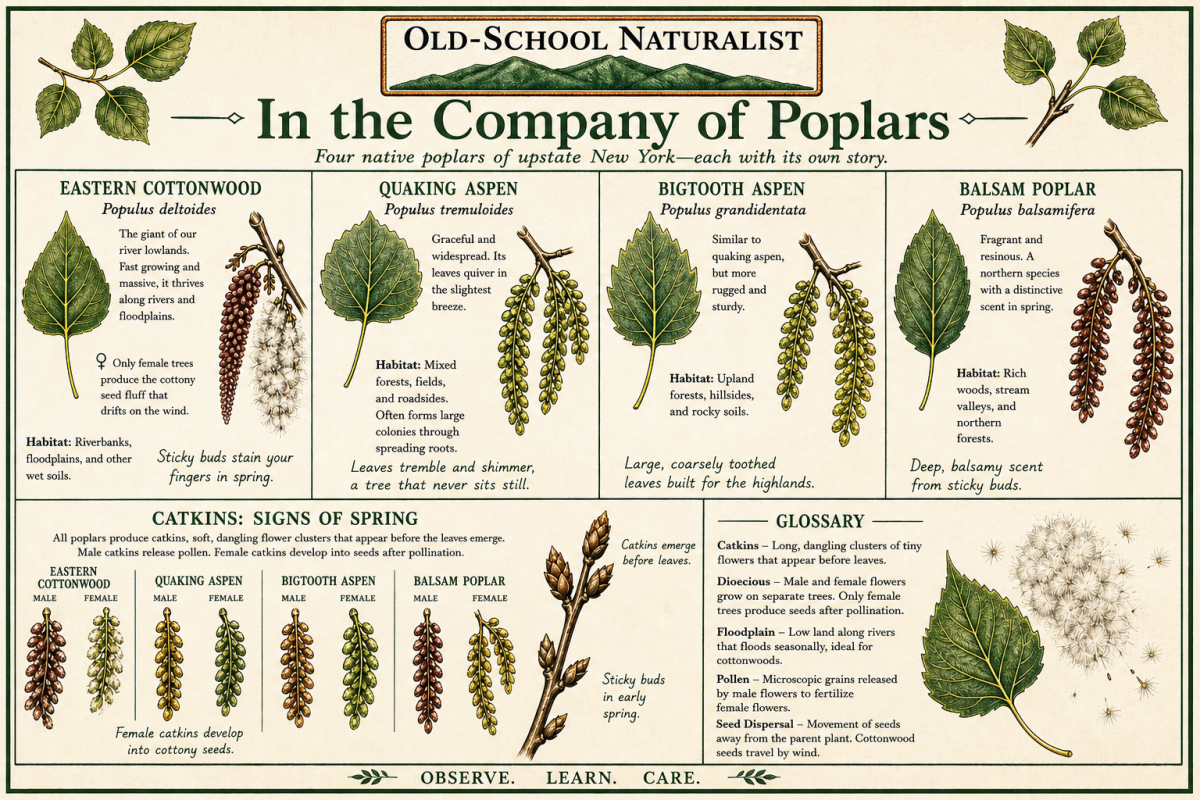
Built in the mid-1800s by my third great-grandfather, John Fife Mein, the trees were likely just seedlings then. By the time I was born, they were enormous.They were the kind of trees that required multiple people, arms outstretched, to encircle them. They stood like sentinels on the riverbank, watching over generation after generation of our family.They were there when, as a barefoot five-year-old, I was first let loose to wander through the yard with a basket in hand, collecting whatever natural treasures I could find. In the fall, as the weather turned colder, my younger brother Phil and I were fascinated by how hundreds of ladybugs gathered in the crooks at the base of those immense trunks. And then, out of nowhere, their branches hosted thousands of starlings, filling the air with their raucous cries.They were there when we learned to ride our bikes in the shadows of those giants, falling again and again until we got it right. They shaded us for countless games of croquet where the whole family gathered to compete.And they were there on the morning everything changed.I remember family members surrounding my brother Scott, supporting him as he sobbed, walking him across the lawn after we learned that our brother Jeff had died at just 19 years old. The poplars stood over us then, silent and immovable, bearing witness to our successes and our tragedies.Later, after the house had quieted and the children had grown, my parents would make a small fire at night, sitting side by side beneath one of those giants.Now my mother is gone, and my father lives there alone until we all gather again each summer for his July birthday when the leaves will catch the air and sing for us as they always have. This year, he will be 87.And the poplars, those giants that watched it all, are reaching the end of their lives. We have lost two in just the past few years.One thing I will never forget was the sense of renewal they brought each spring; the sticky buds that coated your fingers in yellow-green resin if when you touched them, the little red “caterpillars” that appeared before the leaves. We loved to play with them as children, never knowing they had a name.Catkins.Years later, after building a life of my own here in the foothills of the Catskills, I encountered those trees again in a completely different way.The first time was at Henry Hudson Park along the Hudson River in Selkirk. We happened to be there at just the right moment in spring, when the air was suddenly filled with drifting white, soft and featherlike, floating in waves through the park.It looked like snow.I remember wondering what kind of tree they were coming from.And then realizing these, too, were poplars.In upstate New York, what we casually call poplars are part of the Populus family, and there are four native species that shape our landscape in very different ways.Eastern cottonwood (Populus deltoides) is the giant of the group, often found along rivers and floodplains. These are the trees with the sticky buds and the reddish spring catkins. Only the female trees produce the drifting white seeds, the cotton that fills the air.Quaking aspen (Populus tremuloides) is more delicate in appearance, with pale bark and leaves that tremble in even the slightest breeze. You will find them in mixed forests and old fields across much of the state, often forming entire stands that shimmer in the wind.Bigtooth aspen (Populus grandidentata) is similar but more rugged, with larger, coarsely toothed leaves, often found in upland forests.And balsam poplar (Populus balsamifera), more common in the northern parts of the state, carries a deep, resinous scent from its buds in spring.All of them produce catkins, those soft, dangling flower clusters that appear before the leaves.But not all produce the same experience.That drifting white “snow” I saw along the Hudson River in Selkirk comes only from female cottonwoods, often in places where conditions are just right, open river corridors, floodplains, and the right winds to carry them.Which may explain why I never saw it growing up.Same family. Different expression.Now, in the foothills of the Catskills, I see it again.Across the field. Along the edges. In the distance.That soft drift of cottonwood seeds will soon move through the landscape.And I know the time is coming when I will be sitting on my own porch, watching it float toward me, just as I once stood in a park along the Hudson River in Selkirk, and beneath the towering poplars of my childhood.The same family of trees.
The same quiet presence.
Still carrying the story forward.And if you are paying attention, you may see it too.Look for the drifting white along the edges of fields and rivers. Watch the branches before the leaves arrive. Notice what appears before you expect it. This is the way of the Old-School Naturalist.Come back next week, when we will explore more of what the fields and forests of upstate New York have to offer.