Columns
Make Way for Woolies
OLD-SCHOOL NATURALIST
Notes from the Fields and Forests of Upstate New York
Make Way for Woollies By Marlene McTigue
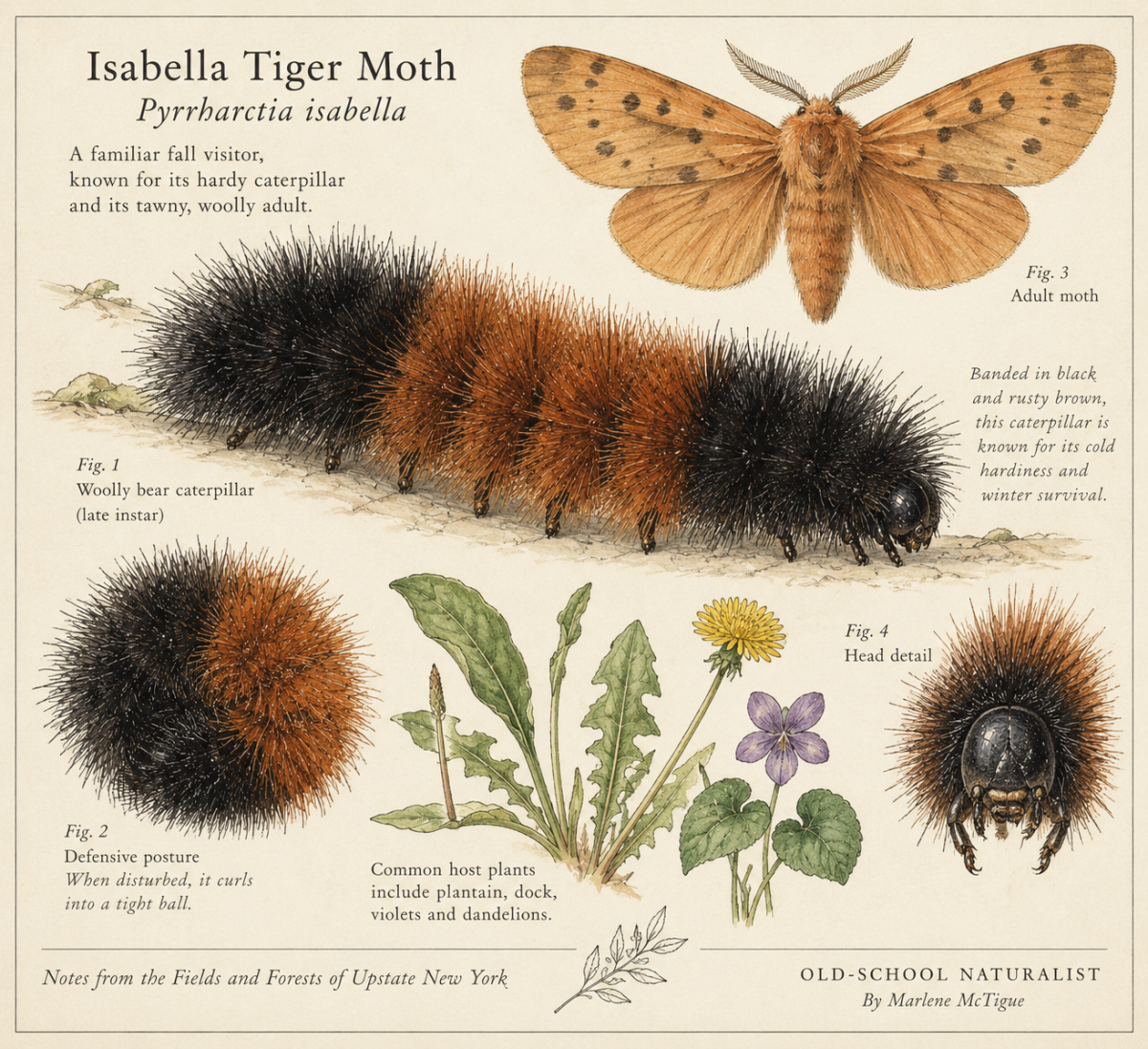
It happens every year. By the middle of September, somewhere along a country road you’ll travel or making its way across your driveway, a woolly bear caterpillar begins an improbable journey.
Barely two inches long, cloaked in rusty brown and black bristles, it marches with complete confidence across a world built for creatures thousands of times its size. It doesn’t hesitate. It doesn’t know what a road is. It simply knows it has somewhere to go. And when you see one, maybe you slow down and do what you can to give that tiny traveler safe passage. It takes only a few seconds.Yet I suspect many of you do exactly the same thing.
Why? Because you’ve noticed. You now hear the quiet drone coming from a patch of goldenrod and, instead of walking past, you stop to look, appreciating the busy work of dozens of bees and wasps moving from flower to flower, work that helps ensure their survival.
Maybe you stop to admire a dragonfly drying its wings beside a pond, or pause before your next footfall to make sure the red eft makes its slow, bright journey across the damp trail safely.
These lives were always there. The difference is that now we see them. And perhaps, over time, we begin to see them not simply as wildlife, but as individuals.
The porcupine in the tree becomes Herman. In case you missed it, you can read about Herman here- https://old-schoolnaturalist.com/website/index.php?detail=blog-detail&article=Understanding-Herman&num=692
The turtle crossing the road becomes the turtle you tell your kids about, the one you stopped and helped safely to the other side. And once you’ve learned to see them, it becomes surprisingly difficult to ignore them.
The woolly bear is a perfect example. For generations, we’ve repeated the old story that the width of its rusty band predicts the coming winter. It’s a wonderful bit of folklore, but the truth is even more remarkable.
In fall, woolly bears begin searching for protected places where they can spend the winter. Beneath leaves, under bark or tucked into some other sheltered spot, they will endure months of cold in an extraordinary state of survival. Their bodies produce natural cryoprotectants that help protect their cells as temperatures fall, allowing them to survive cycles of freezing and thawing through the winter. They may freeze and thaw repeatedly as winter temperatures rise and fall, only to resume their lives when warmer days return.
When spring returns, they become active again before eventually transforming into Isabella tiger moths. That little caterpillar we see each fall making its way across the pavement is a living being, an individual, in the middle of an extraordinary act of survival.
Knowing that changes the crossing somehow. And once you notice one small life, you start noticing others. A turtle crossing a road in June isn’t an obstacle. She is trying to get somewhere, perhaps to a nesting site. And you’re not alone if you’ve begun noticing and acting with a little more compassion.
This summer, I returned to my childhood home in St. Lawrence County and noticed something along a stretch of road between Louisville and Norwood that hadn’t been there when I was growing up: turtle crossing signs.
They can be raised during May and June, when turtles are making their annual journeys to nesting grounds, and lowered again when the season has passed.There was something about those signs that stayed with me.
Someone had noticed. Someone had recognized that this particular stretch of pavement crossed a route turtles had probably been traveling long before the road was there. And someone had decided to do something about it. That is what noticing can do.
It’s being the person who waits after a bird strikes a window, realizes it isn’t recovering and needs a little extra help, then carefully places it in a ventilated box and calls a licensed wildlife rehabilitator.
It might mean leaving some leaves beneath the trees this fall, knowing that the woolly bear you saw making its way across your driveway may find the shelter it needs to survive the winter there.
It might mean planting native flowers next spring, providing food and habitat for the insects and birds that evolved alongside them.
Or it might mean turning off an unnecessary outdoor light at night, when artificial light can disrupt the lives of moths and other night-flying insects.
None of this means we can live without affecting the natural world. We can’t.
Every road, every house, every trail and every garden changes something. But awareness can change behavior.
Noticing makes us pause. It allows us to consider the lives around us and to recognize that we share this landscape with countless other creatures, each following rhythms far older than our own.
Maybe that’s one of the quiet gifts of becoming an old-school naturalist.You don’t just learn the names of birds or wildflowers (although you probably will), you begin moving through the world differently. A little more slowly. A little more thoughtfully. A little more gently.
Soon, woolly bears will be making their autumn journeys all across Upstate New York, crossing roads with no notion of the dangers we’ve built around them.
When you see one, make way.
Then keep looking.There are a hundred other small lives all around us, and what happens to them can be altered by what we choose to do next.
See you back here next week, naturalists.
Until then, keep doing the good work of noticing.