

Columns
The Day the Woods Turned Blue
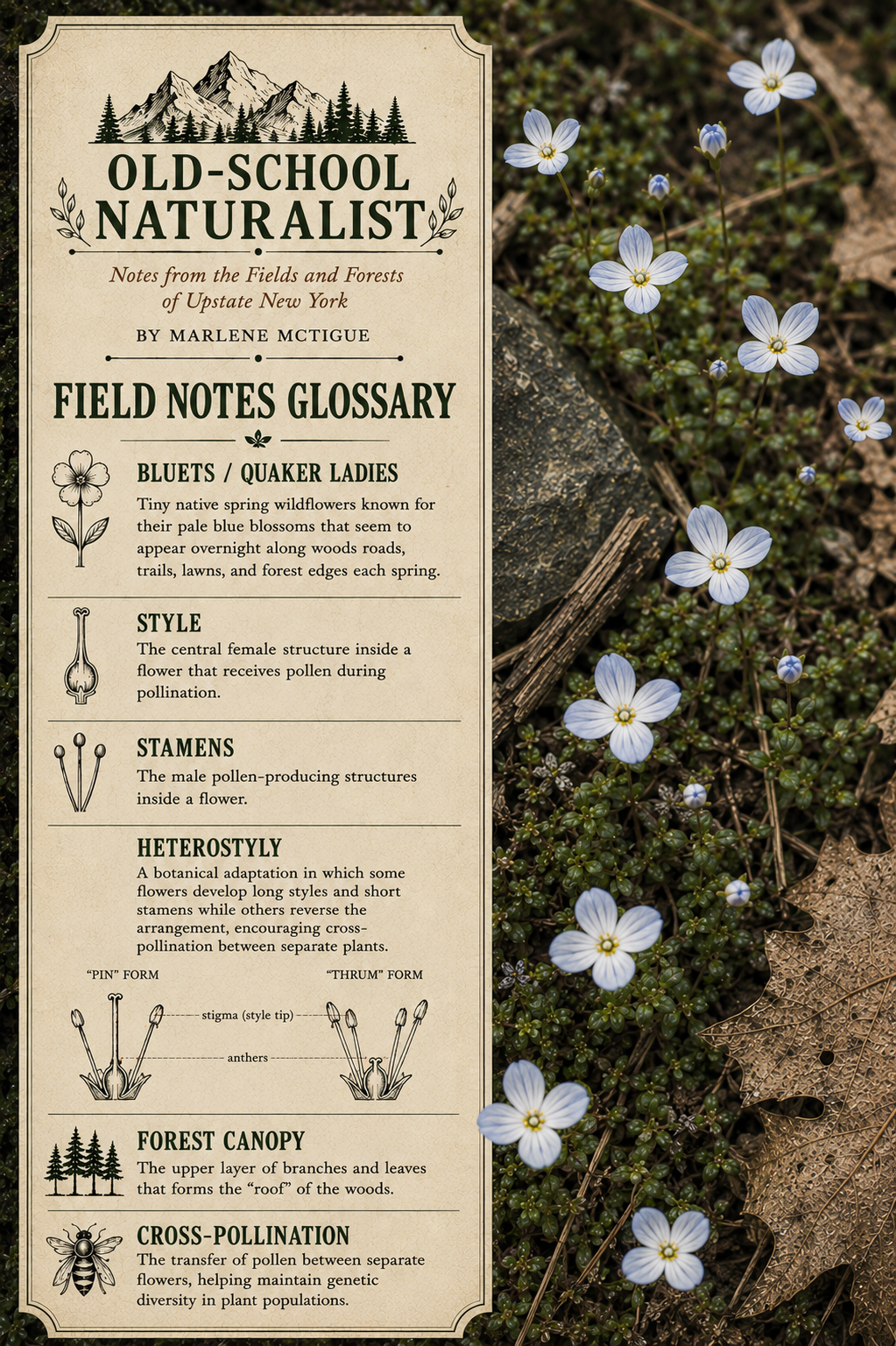
Old-School Naturalist: Notes from the Fields and Forests of Upstate New YorkThe Day the Woods Turned BlueBy Marlene McTigueThe woods are beginning to offer small gifts again.Not all at once, of course. Spring never arrives in a single motion in upstate New York. The nights still carry cold air down from the hills. Last autumn’s leaves remain pressed into the trails. Much of the landscape still waits in muted browns and silvers beneath bare branches.And then one morning, almost as if the forest changed overnight, a blue wonder has arrived.Not the loud blue of nursery flowers lined up in plastic trays outside a garden center. This is something far older and softer than that. Tiny flecks scattered through the woods like fragments of fallen sky tucked beneath the leaves.Bluets.The tiny native wildflowers, also known as Quaker ladies, are blooming now throughout the region. They appear along woodland edges and old logging roads, where the flowers sometimes bloom directly between the tire tracks, turning muddy ruts into pale blue pathways winding through the woods. In some places they spread so thickly that entire patches of forest floor seem washed in blue.Still, if you are not paying attention, you could walk right by.But an Old-School Naturalist knows the delight of suddenly coming upon them deep in the woods. The joy is not only in grand vistas or dramatic wildlife encounters. Sometimes it is found in stopping in the middle of the trail to admire flowers barely larger than a pencil eraser.And what flowers they are.Each blossom carries delicate blue petals surrounding a tiny yellow center that acts as a guide for pollinators. Their scientific name, Houstonia caerulea, places them in the coffee family, which feels wonderfully improbable for something so small and fragile-looking.But bluets carry another secret as well.If you kneel down and study them closely, you may notice that not every flower is built the same way. In some blossoms, the central style rises high while the stamens remain tucked lower inside. In others, the arrangement is reversed, with the stamens reaching upward while the style sits deeper in the flower.Botanists call this heterostyly, and it is one of the bluet’s remarkable strategies for encouraging cross-pollination. A bee brushing against the higher parts of one flower will carry pollen at a certain spot on its body, then unknowingly deposit it onto another flower built in the opposite arrangement. It is an elegant little system hidden inside blossoms so tiny most people never stop to examine them at all.Bluets thrive where tougher-looking plants sometimes struggle. Thin soil. Gravelly ground. Hard-packed earth beside trails and back roads. They bloom before the forest canopy fully leafs out, taking advantage of the brief window when sunlight still reaches the forest floor.And every year, they seem to arrive just as the woods themselves begin stirring awake again.This week, if you walk slowly enough, you will likely find them. Maybe beside a mossy stump. Maybe winding through an old woods road. Maybe gathered in little constellations beneath the trees.Tiny enough to miss entirely.Beautiful enough to stop an Old-School Naturalist in their tracks.And they are only one of the countless wonders waiting in the fields and forests around us, if only we choose to step inside and notice them.Come back next week. There are more natural wonders waiting for you along the trail.