

Columns
The Secret Life of Trees
OLD-SCHOOL NATURALIST- Notes from the Fields and Forests of Upstate New York
The Secret Life of Trees By Marlene McTigue
No doubt you’ve heard the stories. Trees talk to one another. They warn their neighbors of danger. They feed their young. Beneath our feet, an invisible network carries messages from one end of the forest to the other.
It sounds a little like Treebeard and his Entish brethren wandered out of Middle-earth and into a biology textbook. The truth is both less fanciful and, to my mind, every bit as remarkable.
Back in 1983, researchers Ian Baldwin and Jack Schultz at Dartmouth discovered that when young poplars and sugar maples were deliberately damaged, nearby undamaged plants began changing their own leaf chemistry. The researchers proposed that airborne chemical cues might explain the response.
Then, in 1997, forest ecologist Suzanne Simard and her colleagues demonstrated that carbon could move in both directions between paper birch and Douglas fir in a British Columbia forest. Their findings suggested that underground fungal connections played an important role in the exchange. Eventually, somebody gave this hidden world an irresistible nickname, the “Wood Wide Web.”
And that’s where the story began to get ahead of the science. Trees talk. Mother trees feed their children. Trees warn their friends.
Those phrases make for great headlines, but scientists are still debating exactly what these exchanges amount to.
Carbon and other substances can move among plants and fungi. Plants can respond to chemical cues. What we cannot do is assume intention.
An oak is not leaning over to whisper a warning to the maple next door. And frankly, it doesn’t need to. The reality is strange enough. Perhaps the greatest lesson of all this research isn’t that trees communicate, but that we’ve spent centuries walking among them without understanding much of what goes on around us. And the more I learn, the more I wonder what else I’ve been missing.
Some mysteries require sophisticated instruments to uncover. Others require nothing more than stepping off a familiar trail and looking inside an old oak.
I was reminded of that the other day while standing beside an old oak along my usual walk. I call it the tri-oak because three enormous sections once rose together from one massive base.
Now there are two. One of those great sections had fallen, exposing the interior of the tree. I went closer, expecting to see solid wood. Instead, the center was dark, soft and spongy with decay. And yet, above that decaying heart, the rest of the oak was still very much alive.
That sounds like a contradiction until you know one of the great secrets of trees: much of a large tree is already dead. The heartwood at the center consists of cells that are no longer carrying on the living business of the tree. Water travels primarily through the younger sapwood, farther out. Just beneath the bark, remarkably thin living tissues continue producing new wood and inner bark.
An old tree can become hollow and continue leafing out year after year. Hollow does not necessarily mean dying. It can, however, mean vulnerable.
Decay can leave less sound wood to support tremendous weight, which helped explain the great section now lying across my trail.
But there was more. For years, leaves and twigs had been falling into the space where those three great sections met. Season after season, they gathered there, softened, darkened and became soil. And at some point, a maple samara came spinning down through the canopy. Of all the places it might have landed, it came to rest in that little pocket of earth held in the arms of an oak.
It germinated. It grew. And by the time I discovered it, that maple was no sapling. It rose from the center of the tri-oak and towered above me.
How long had it been there? How many times had I walked past without ever looking beyond the oaks?
A seed had fallen from one tree, found earth inside another and quietly become a tree of its own. All of it beyond my notice.
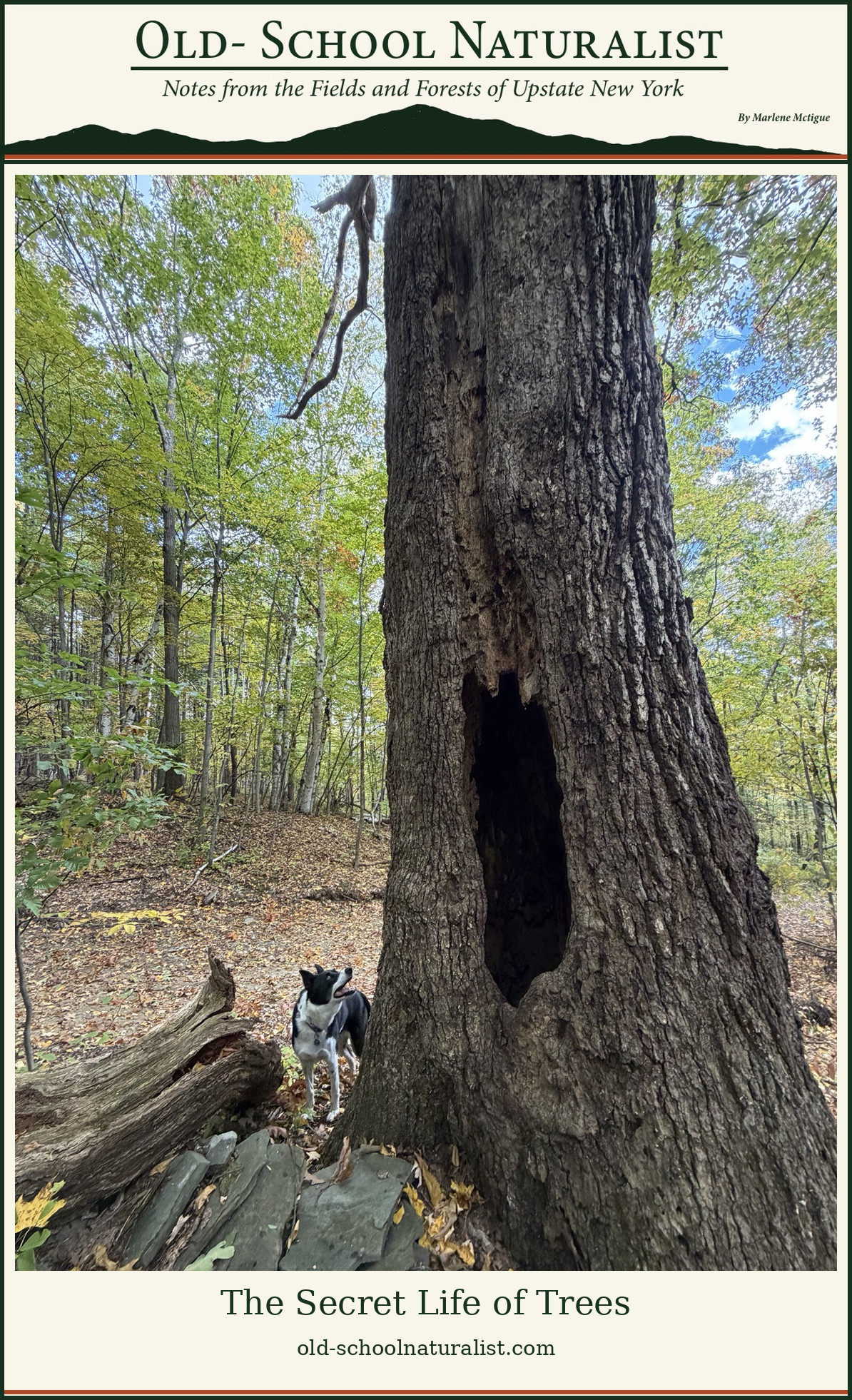
That wasn’t the first hollow tree along these trails to surprise me. There is another mammoth old oak I call Hampton. His trunk is so completely hollow that two people could stand inside him.The first time I left the trail and went over to look inside, I saw a raccoon lying on the earth at the bottom.
At first, I thought he was sleeping. Then I wondered if perhaps he was sick or injured and had crawled into the shelter of the old tree to be left alone. I leaned in for a closer look and realized he had passed away.
And suddenly, right beside my face, a porcupine came skittering up the inside of the tree. I jumped back.
I returned a week later. There wasn’t a sign of the raccoon or the porcupine.
Still Hampton stood, hollow but alive, holding within him a little world I never would have known existed if I hadn’t stepped off the trail.
Yesterday, I found another secret among the fallen acorns. Dozens lay scattered beneath the oaks, and when I bent down to look more closely at one of them, something white had broken through the shell.
A radicle. The first root of a new oak. It had already begun reaching down toward the earth. I know what comes next because I see it here year after year.
Most of these acorns will never become mature trees. But some will find the right patch of earth. A root will take hold. A shoot will rise. And someday, where an acorn once disappeared beneath the leaves, there may stand an oak.
Perhaps that is the real secret of trees. So much is happening where we cannot see it.
Beneath the soil, roots and fungi exchange resources. Within the hollow trunks of ancient oaks, other lives find shelter. And under the fallen leaves, a new generation is already taking hold.
Science is helping us understand some of these mysteries. Others reveal themselves only when we slow down long enough to notice.
The trees have been keeping their secrets a long time. It’s up to us old-school naturalists to slow down, pay attention and discover what they might reveal next.
Come with me next week, and we’ll see what else they’re willing to give away.