

Columns
Your Invisible Neighbors
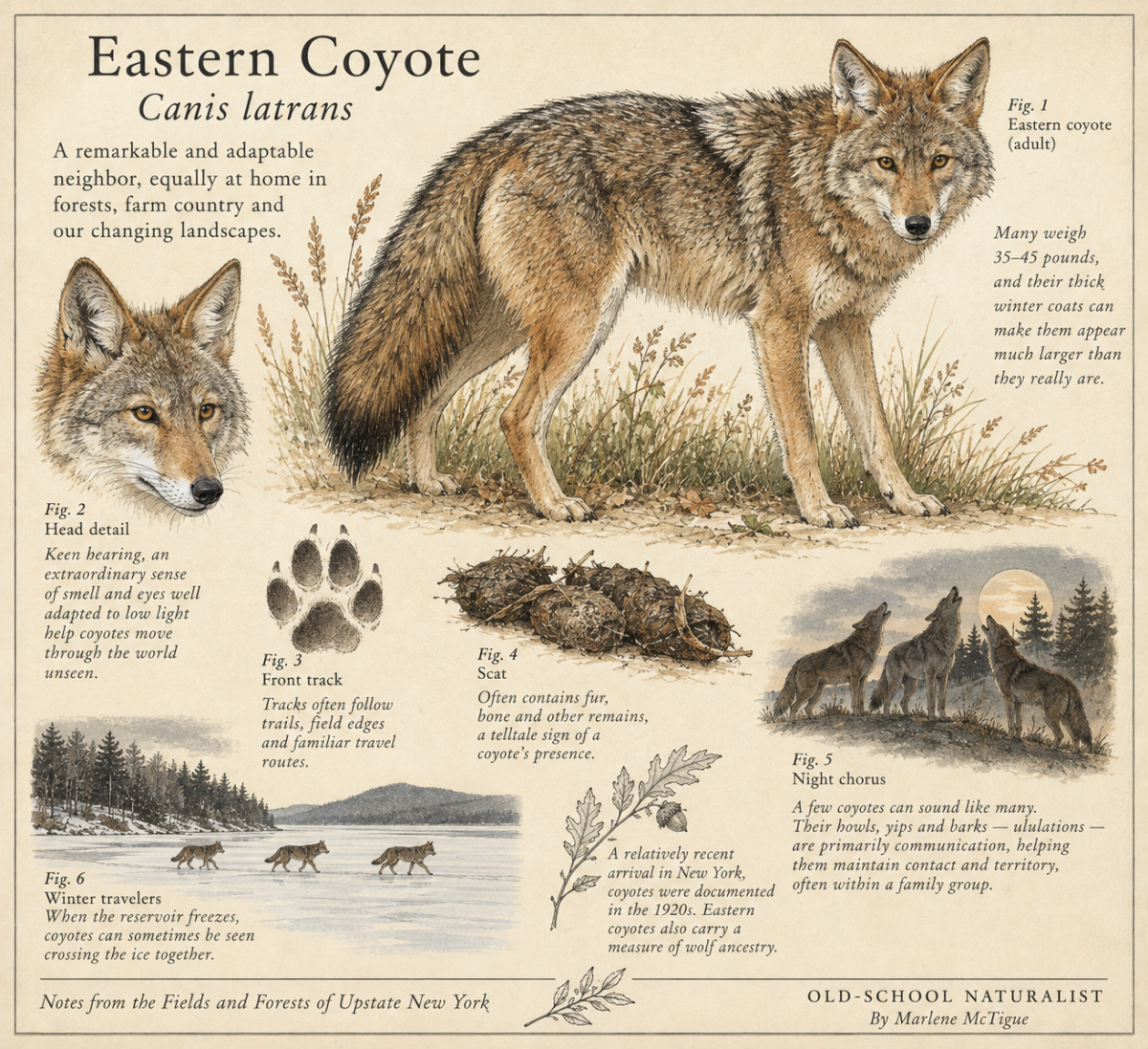
Your Invisible Neighbors by Marlene McTigue
Odessa came jaunting back into view through the woods with a coyote trotting beside her. For one ridiculous second, the scene registered as nothing more alarming than a dog returning with a new friend. Odessa certainly seemed to think so. Her ears were up, her tail was wagging, and she was entirely at ease.Then came the realization.This was not some neighbor’s dog she had encountered on the trail. This was a neighbor of an entirely different sort.
“No!” I shouted in the most commanding voice I could muster.
The coyote veered away, stopped a short distance off, and looked back.
“No!” I shouted again.
This time, it disappeared into the woods as quietly as it had appeared.
In roughly 25 years of walking these fields and forests, I have seen exactly two adult coyotes on these trails. And never a single pup. Yet their presence is unmistakable.
On the trail down the hill, their scat appears regularly, particularly near the place where the field narrows and slips into the forest. Further along, Odessa often erupts into a sniffing storm, her nose working furiously over a fallen branch that seems unremarkable to me.
And then there are the nights.
One coyote calls from the woods across the road. Another answers. Howls rise and fall. Yips tumble over barks. Voices overlap until what began as one animal sounds like an entire gathering beyond the porch light.
There is a wonderful word for that wavering cry: ululation. Coyotes are masters of it. A handful can sound like a multitude, but what seems like a great pack gathering in the darkness may be something more intimate: a family talking to one another.
A breeding pair may be joined by that year’s pups and sometimes older offspring. The pups chase, wrestle and pounce, preparing for the business of being coyotes. A typical litter numbers four to six pups. And contrary to the old notion that a burst of howling means coyotes have made a kill, their calls help them maintain contact, advertise territory and locate one another.
For years, Odessa listened to those calls without making a sound of her own. For the first four and a half years she lived here, we never heard her howl. Many nights, especially in winter, she would stand on the front porch, head tilted, ears cocked toward the darkness, and simply listen. Then one night, when she was about five, we heard the first howl she had ever made. She lifted her muzzle and answered them in what seemed like their own language. We stood there in delighted wonder. After years of listening, she had found a voice we never knew she had. She has been joining the conversation ever since.
Coyotes are so much a part of the upstate landscape that it is easy to imagine they have always been here. They haven’t.
Coyotes entered New York through the northern part of the state in the 1930s and 1940s, after traveling through Canada north of the Great Lakes. From there, they spread southward, eventually becoming established here in the Capital District and across Upstate New York. Along the way, they interbred with wolves, which is why eastern coyotes carry some wolf ancestry.
An eastern coyote weighs around 40 pounds, about the same as Odessa, though its thick coat can make it look larger. With keen hearing and an extraordinary sense of smell, it can live close to people while remaining difficult to see. Most of the time, a coyote knows we’re there long before we know it is. I had no idea one was nearby that day until it appeared beside Odessa.
For generations, people shot, trapped, and poisoned coyotes. Yet efforts to eliminate them failed. They spread through forests and farm country, suburbs and cities, finding ways to live alongside us. The coyote beside Odessa looked enough like the dogs we welcome into our homes to fool me for one fleeting moment. Then it slipped back into the woods. Most days, that is how it goes. We find their tracks and scat, hear their voices after dark, but never see them.
Winter sometimes gives them away. When the reservoir freezes, coyotes can be seen crossing the ice. Once, we watched three walking abreast across that enormous expanse of white. They reached the far shore and disappeared into the woods.
Twenty-five years. Two coyotes on the trails. Not a single pup.
Those numbers might suggest coyotes are rare here. The reality is something quite different. They have walked these trails while we walked them. They have raised families in forests we thought we knew. They have watched us pass without ever stepping from the shadows. And they have known we were here all along.
So the next time the darkness outside your window erupts in yips and howls, resist the urge to close the window.
Open it.
Listen.
Your neighbors are talking.
Come back next week for another look into the fields and forests of Upstate New York.